Materials
Is a Trench Coat Waterproof? And Is It Warm Enough for Winter?
The short answer
A classic trench coat is water-resistant, not waterproof: cotton gabardine sheds showers and wind, but sustained rain soaks through the cloth and sewn seams. Burberry itself calls its gabardine shower-resistant. Nor is a trench a winter coat on its own; it is a shell worn over a jacket or knit, warm enough for autumn with a wool cloth or a button-in liner. For real rain choose a membrane such as Gore-Tex or Sympatex; for real cold, a wool overcoat, loden or shearling.

A classic trench coat is water-resistant, not waterproof, and it is not a winter coat on its own. Cotton gabardine sheds a shower and stops the wind, but sustained rain eventually soaks through the cloth and the seams. Warmth comes from what is under it: a wool trench, a button-in liner or a knit beneath it takes one through a cold autumn, but in real winter cold the trench is a shell, not the insulation. If you need a coat that is genuinely waterproof, look for a membrane such as Gore-Tex or Sympatex on the label.
Is a trench coat waterproof?
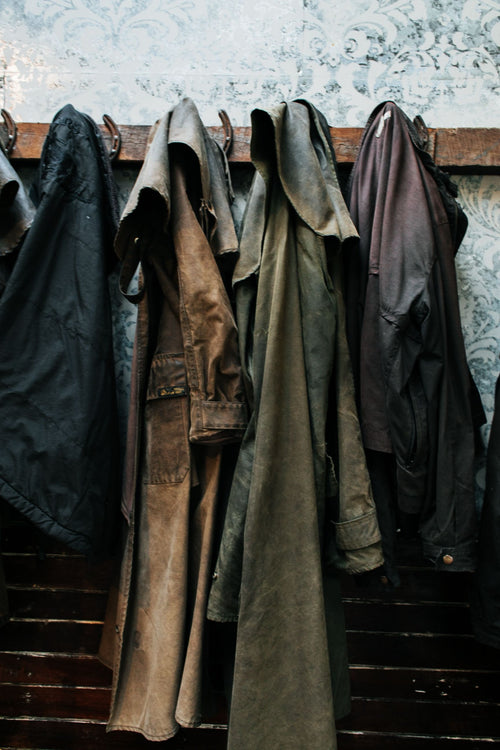
Not in the strict sense, and its makers have never claimed it was. Burberry, whose gabardine defines the classic trench, describes the cloth on its own Heritage trench coats as shower-resistant. That is the honest word for it. A tightly woven twill sheds a passing shower and stops the wind, but a long, heavy downpour eventually works through the cloth, and above all through the seams, which on a traditional trench are sewn rather than taped.
"Waterproof" has a measurable meaning in outerwear. Fabrics are tested for hydrostatic head: how tall a column of water, in millimetres, the cloth holds back before it leaks. Outdoor makers treat thousands of millimetres as the starting point for a waterproof jacket. A woven cotton or wool trench is not built for that test. It is built to breathe, which a rubberised raincoat never did.
Why gabardine resists rain at all
The trench coat's rain resistance comes from the cloth, not from a coating. In the late 1870s Thomas Burberry developed gabardine, a tight twill in which the yarn was proofed before weaving, with lanolin in the original version, rather than the finished cloth being coated afterwards. He patented it in 1888. The result was lighter and far more breathable than the rubberised cotton of the time, which kept rain out and sweat in.
Aquascutum, founded on Regent Street in 1851, took its name from the same ambition: Latin for "water shield", after a patented weatherproof wool cloth. British officers wore its coats in the Crimean War. Between them, the two houses produced the cloth from which the officers' coat of the First World War was cut, and that coat was always a weatherproof, never a waterproof in the modern sense.
Is a trench coat warm enough for winter?
On its own, usually not, because it was never designed to be the warm layer. The First World War trench coat was a privately bought officer's weatherproof, worn over the uniform. For warmth, officers had a different coat entirely, the heavy wool British warm. The trench's job was to keep wind and rain off whatever was underneath.
That is still the right way to think of one. How warm a trench feels depends on three things.
- The cloth. A cotton gabardine trench is a spring and autumn coat. A wool or wool-blend trench, and there are many among vintage pieces, is noticeably warmer and wears well into early winter.
- The liner. Many trench coats, from the classic makers to mid-century American labels, were sold with a button-in or zip-out wool or fleece liner. On a vintage coat, check whether the liner is still there. Buttonholes or a zip running around the inside of the facing mean one was made for it.
- What you wear under it. A trench is cut with room for a jacket or a heavy knit. Over a cashmere jumper or a tailored wool jacket, a gabardine trench handles a cold, dry day better than its weight suggests, because it stops the wind.
For freezing weather, snow or a long wait outdoors, a trench is the wrong coat. A wool overcoat, a loden or a vintage shearling coat does that job, and our guide to the best natural fibre for a winter coat compares them.
Water-resistant, waterproof, membrane: how to tell what you have
| What the label or cloth says | What it means in rain |
|---|---|
| Cotton gabardine, poplin or twill | Sheds showers and wind; soaks through in sustained rain. The classic trench. |
| Wool or wool blend | Warmer, naturally resists a light shower; heavier when wet. |
| Gore-Tex | A waterproof, breathable membrane of expanded PTFE bonded inside the cloth. Genuinely waterproof if the seams are sealed. |
| Sympatex | A pore-free polyether-ester membrane: waterproof, and breathable through the membrane itself. |
| Polyester or nylon shell, no membrane | Usually showerproof from a surface finish, which wears off with age and washing. |
A membrane is the only reliable route to a trench that keeps out a full day's rain. Vintage examples exist: the shape is classic, and the cloth inside is modern.
Can you re-proof a vintage trench?
Often, yes. The water-shedding finish on most trench cloth wears with age and cleaning, and it can be renewed. The general method, from makers of re-proofing products, is to clean the coat first, then apply a spray-on proofer (sprays suit uncoated cloth better than wash-in products, which are meant for membranes), and set it with gentle heat. On an old cotton or wool coat, air-dry or use a hairdryer on low rather than a tumble dryer, and test on a hidden area such as the inside of the hem first. For a valuable Burberry or Aquascutum, ask a specialist cleaner before trying it at home.
So, should you buy one?
Yes, for what it is: the best coat there is for the long, changeable middle of the year, wind, showers and the cold mornings of spring and autumn, worn over a jacket in a city. A well-made vintage trench in good gabardine or wool has already outlasted its first decades, and a good one will outlast the next. Just don't ask it to be a winter coat or a mountain jacket. For both, pick by the cloth on the label.
For the coat's history from the 1910s to today, read Trench Coats by Decade.
Common questions
Are trench coats waterproof?
A classic cotton gabardine trench is water-resistant, not waterproof. It sheds a shower and stops the wind, but sustained rain soaks through the cloth and the sewn seams. Burberry itself calls its gabardine shower-resistant. Only a trench with a membrane such as Gore-Tex or Sympatex is genuinely waterproof.
Is a trench coat a raincoat?
It is a weatherproof rather than a true raincoat. It was designed to keep off showers and wind while breathing, which rubberised raincoats did not. For heavy or all-day rain, a membrane coat or a rubberised raincoat is drier.
Are trench coats warm?
Not on their own. A trench is a shell meant to be worn over a jacket or knit. A wool trench or one with a button-in wool liner is warm enough for autumn and mild winter days; for freezing weather, choose a wool overcoat, loden or shearling.
Can you wear a trench coat in winter?
In a mild winter, yes, with a liner or a warm layer beneath. In real cold or snow, no: the trench has no insulation of its own. First World War officers wore a separate wool coat, the British warm, for warmth.
How can I make a trench coat more waterproof?
Clean it, then renew the water-repellent finish with a spray-on proofer and set it with gentle heat. Test on a hidden area first, and ask a specialist before treating a valuable vintage Burberry or Aquascutum.
What is trench coat weather?
Cool, changeable weather: roughly spring and autumn, with wind, showers and cold mornings. It is the weather the coat's water-resistant, breathable cloth was made for.
Keep reading

 Trench Coats by Decade: From the 1910s Trenches to Today
The trench coat is a twentieth-century garment. It began as a privately bought British officer's weatherproof in the First World...
Read more →
 The Best Natural Fibre for a Winter Coat: All Ten Compared
For a winter coat, cloth weight decides warmth before fibre does — 600–700 g is the standard weight for a...
Read more →
 What Does Loden Mean? The Cloth, the Process and the Names Inside
Loden comes from lodo, Old High German for coarse cloth, and today means woven wool that has been felted, made...
Read more →
 Vintage vs Fast Fashion in 2027: The Quality Shift and a Buyer’s Guide
By 2027 the evidence points one way: resale clothing is growing faster than new clothing, shoppers rank quality second only...
Read more →
 How to Get the Smell Out of a Vintage Coat: Smoke, Must and Mothballs
Start with the cause: most smells in a vintage coat are smoke, mustiness or mothballs. Air the coat somewhere dry,...
Read more →
 How Heavy Should a Winter Coat Be? Cloth Weight Explained
A winter overcoat for a temperate climate is usually cut from cloth of roughly 530 to 750 grams per linear...
Read more →
 Can a Leather Jacket Be Altered? Fit, Stretch and What a Tailor Can Change
Yes, but only in one direction. A tailor who works with leather can shorten the sleeves, take in the sides...
Read more →
 What Kind of Fur Is My Coat? How to Identify Mink, Sable, Fox and More
Check the label, the hair and the construction, in that order. A US label made since 1952 must name the...
Read more →
 Shearling vs Sheepskin: Is There a Difference?
Shearling and sheepskin are in practice the same material: a sheep or lamb skin tanned with the wool left on....
Read more →
 What Is a Penny Lane Coat? The Film Coat and the Afghan Original
A Penny Lane coat is a long coat with a shaggy collar and cuffs, usually in suede or sheepskin, named...
Read more →
 Astrakhan, Persian Lamb, Swakara: Four Words, One Sheep
Astrakhan, Persian lamb, Swakara and karakul all describe the pelt of the same animal — the Karakul sheep of Central...
Read more →
 How Can I Tell Real Fur From Faux Fur?
Part the pile and look at the base. Real fur is attached to a tanned skin, like thin leather; faux...
Read more →
Every piece in the archive is one of a kind. When it is gone, there is no second one.
Measurements, more photographs, a closer look at a label: write to us before you order, or use the live chat.
Sources
- Burberry: Heritage trench coats: gabardine described as a shower-resistant fabric invented by Thomas Burberry.
- Textile Research Centre, Leiden: Gabardine: twill weave; lanolin applied to the yarn before weaving; patented 1888.
- Chemistry World: Lanolin: Burberry gabardine proofed with lanolin; comparison with rubberised cloth.
- Smithsonian Magazine: The Classy Rise of the Trench Coat: rubberised cotton; Aquascutum and the Crimean War; officers' private purchase.
- Grace's Guide: Aquascutum: founded 1851 on Regent Street; weatherproof wool; military coats in the 1850s.
- Wikipedia: British warm: the officers' wool coat worn for warmth.
- Sea to Summit: Just how waterproof is waterproof? and Advnture: Waterproof versus water-resistant: hydrostatic head and what counts as waterproof.
- Gore-Tex: the membrane and Sympatex: Q&A: how each membrane keeps water out.
- Practical Boat Owner: reproofers tested and SectionHiker: DWR treatments: cleaning, spray versus wash-in, heat activation.