Styling
How Should a Trench Coat Fit? Shoulders, Sleeves, Length and Belt
The short answer
There is no single correct trench coat fit: a tailored trench should skim the body with room for your usual layers, while a relaxed or oversized one works when the extra room is deliberate. Check the shoulder seam, sleeves over the cuff, a flat fastened front, a comfortable belt and a hem that does not drag.
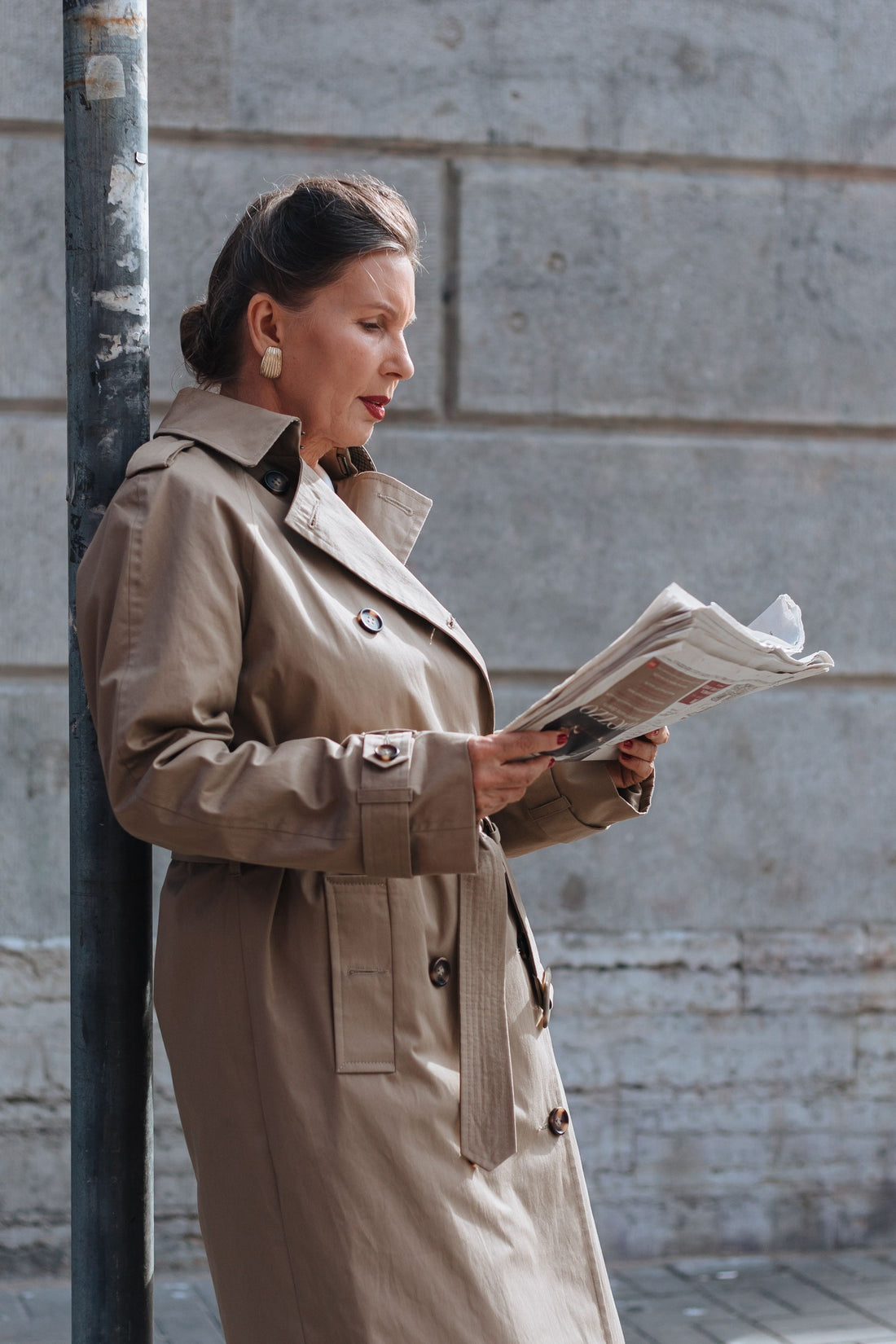
There is no single correct trench coat fit. A tailored trench should skim the body with enough ease for the layers you actually wear; a relaxed or oversized one is just as valid when the extra room looks deliberate. Judge any coat on your own frame, buttoned, over your usual layer, and while moving, not by the size on the label.
The checks below work for any trench, new or vintage. Vintage trenches are often cut differently from today’s, with fuller backs, lower waists and longer lengths, so the ideas matter more than the numbers. You can see the range in the trench coats in the Vestiaire. If you want the same checks for an overcoat, read how an overcoat should fit.
How should a trench coat fit through the shoulders?
On a coat with set-in sleeves, the shoulder seam should sit at the edge of your shoulder, or just beyond it to allow for layers. On a raglan or deliberately relaxed cut the line is different, so check that it lies smooth rather than bunching, digging in or restricting your arms. A ridge where the sleeve meets the body, or a shoulder that collapses far down the arm without being designed to, means the cut or the size is wrong for you.
Where should the sleeves end?
With your arms relaxed, the sleeves should cover the wrist and usually the shirt cuff. Over tailoring, the coat should cover the jacket sleeve too. They should not swallow your hands, and they should not ride up sharply when you reach forward. Trench sleeves often have straps or tabs at the cuff that can be adjusted a little.
How much room do you need in the chest?
Fasten the coat over the thickest layer you expect to wear and check the front lies smooth. Pulling at the buttons, X-shaped creases, a gaping double-breasted overlap or tightness across the upper back all show that the coat is too small for that layer. A coat that only fits over a thin shirt will be frustrating the first cold day you wear a jumper under it.
Where should the belt sit?
It should be comfortable, not cinched so hard that it bunches the cloth. Many people tie it loosely, others knot it at the back or leave it buckled. The position depends on the design and on your proportions, so choose the one that gives you the outline you want. A belt that digs in or forces the coat into folds is a sign to loosen it or look at a different cut.
How long should a trench coat be?
Around the knee is the classic and the most versatile choice. A below-knee or midi trench gives more coverage and a longer line, and a short or cropped trench is a valid alternative if you prefer less fabric around your legs. Check the hem with your everyday shoes: it should not drag, catch on stairs or interfere with your stride. A shorter wearer may find a slightly shorter hem more balanced, but a long coat is not forbidden; it is a question of proportion and preference.
Classic, relaxed or oversized?
- Classic or tailored. A cleaner line through the shoulders and body, polished with thinner layers. Make sure it still closes easily over what you plan to wear.
- Relaxed. More ease through the body and softer shoulders without looking oversized: a good middle ground for knits or tailoring underneath.
- Oversized. A deliberately roomy shape, with dropped shoulders and a generous drape. It should still let you move, and the sleeves should not cover your hands.
Do not size up automatically. It adds room, but it can also lengthen the sleeves, lower the belt and make the shoulders look unintentionally large. Compare the garment’s measurements with a coat you already own and like.
How does the collar and double-breasted front sit?
The collar should rest comfortably at the neck, lie smooth when worn down and still feel comfortable turned up or fastened at the throat. The double-breasted overlap should cover the front cleanly and lie flat when fastened, without straining the buttons or pulling the waist out of shape.
How to try one on
- Wear or bring your usual thickest layer: a sweater for casual wear, a jacket if you will wear it over tailoring.
- Fasten the coat fully and check the front lies flat; do not judge the chest with the coat open.
- Move: reach forward, cross your arms, sit down and walk a few steps. Look for pulling across the back and sleeves that ride up.
- Try it open and belted to see whether it hangs cleanly both ways.
- Check the hem with your usual shoes and on stairs.
- Try the collar down and up.
Common mistakes
- Choosing the size on the label, or sizing up, without checking what happens to the shoulders, sleeves and belt.
- Accepting pulling across the chest because the coat looks good open.
- Reading a slipping shoulder as intentional oversizing, or dismissing intentionally dropped shoulders as a flaw.
- Choosing the hem by a universal rule rather than looking at how it falls on you.
- Cinching the belt hard to create shape when it sits better loose.
For what the cloth, lining and warmth of a trench mean in practice, see is a trench coat warm or waterproof.
Common questions
Should a trench coat be snug or roomy?
Either can be right. A tailored fit should still allow your usual layers and easy movement; a relaxed fit gives more room, as long as the coat does not feel cumbersome.
Should I try a trench coat on over a sweater or jacket?
Yes, over the thickest layer you expect to wear regularly. Fasten it and move around; it should close without pulling or crushing the layer underneath.
Where should trench coat sleeves end?
Usually around the wrist, covering a shirt cuff. Over tailoring, the coat sleeve should cover the jacket sleeve. The cuff should not swallow your hand.
How long should a trench coat be?
Around the knee is the classic length. Below-knee and midi lengths give more coverage, and shorter cuts are a valid alternative. Choose by proportion, comfort and where the hem lands on you.
Can a trench coat be oversized?
Yes. Look for a deliberate relaxed shape with enough control in the shoulders, sleeves and hem to move easily.
How tight should the belt be?
Comfortable, not tight enough to bunch or strain the coat. Try it loosely tied, knotted at the back or buckled, and keep the position that suits you.
Keep reading
 Trench Coats by Decade: From the 1910s Trenches to Today
The trench coat is a twentieth-century garment. It began as a privately bought British officer's weatherproof in the First World...
Read more →
 Is a Trench Coat Waterproof? And Is It Warm Enough for Winter?
A classic trench coat is water-resistant, not waterproof: cotton gabardine sheds showers and wind, but sustained rain soaks through the...
Read more →
 How to Date a Vintage Burberry Trench Coat: Burberrys, Labels and Linings
Read the name on the label. Burberrys, with an s, is the old company name, changed to Burberry in 1999,...
Read more →
 How Should an Overcoat Fit? Classic, Relaxed and Oversized
There is no single right fit for an overcoat. A classic, tailored coat has its shoulder seam at the edge...
Read more →
 What to Wear With an Overcoat: Layers, Trousers, Shoes and Accessories
Wear an overcoat over layers that match its formality: tailoring or fine knitwear underneath, neutral or contrasting trousers, leather shoes...
Read more →
 How Should a Leather Jacket Fit? Shoulders, Sleeves, Chest and Length
A leather jacket should have its shoulder seam on the edge of your shoulder bone, sleeves that end at the...
Read more →
 How to Find a Good Furrier, and What to Ask Before a Repair
Look for a furrier, not a dry cleaner: a specialist whose workroom repairs, cleans and stores real fur. Start with...
Read more →
 Cashmere vs Alpaca vs Mohair: Which Is Warmer in a Coat?
Cashmere is the finest and lightest of the three; alpaca is smooth and dense; mohair is glossy, springy and coarser,...
Read more →
 Can an Old Fur Coat Be Restored? Shedding, Dry Rot and Smells
Usually, if the skin is still supple. Open seams, torn linings, small rips between pelts, dull hair and stale smells...
Read more →
 How to Clean and Store a Fur Coat So It Lasts Decades
Have a fur coat cleaned once a year by a fur specialist, never an ordinary dry cleaner, whose solvents strip...
Read more →
 What Does Deadstock Actually Mean?
Deadstock has two incompatible meanings and no governing definition. In vintage and resale it usually means NOS — New Old...
Read more →
 What Size Am I in Vintage? Why the Label Can't Tell You
The number on a vintage label is not a size. The US sizing standard, Commercial Standard CS 215-58, was published...
Read more →
 Greek Dress and Christopher Nolan's Odyssey: What Ancient Draping Gave Modern Fashion
Ancient Greek dress was almost entirely uncut: rectangles of wool or linen pinned at the shoulders and belted, not tailored....
Read more →
Every piece in the archive is one of a kind. When it is gone, there is no second one.
Measurements, more photographs, a closer look at a label: write to us before you order, or use the live chat.
Sources
- How we wrote this: we compared fitting guidance published across the tailoring and outerwear press, kept the points on which several of them agree, and presented classic, relaxed and oversized fits as equally valid.